
Resistance never strays far from me
Pretend work and real work: AI helps us do both

There’s something strangely attractive about working with an AI. It’s a seducer. Now that I’m using one so often I’m having trouble thinking on my own. That’s not good. I can overcome my thinking trouble by working harder, but I’m naturally lazy. Resistance never strays far from me. Resistance is me scrolling on my phone when there are better things to do.
Working with an AI makes me feel like I’m working even when I’m not. Assigning a task to someone and then playing with the dog while waiting for the task to get done isn’t really working; it’s pretending to work. A lot of management is pretend work. I’ve never been a great manager. To manage well you have to give up control but not ownership. I rarely give substantial feedback on the work I delegate. One reason is that it’s easier for me to delegate things I don’t know much about, like tax preparation. I don’t expect my accountant to prepare my taxes like I would. God forbid! I want them to do the job as they do it. That’s how I’m working with AI — let AI do its work while I do mine, but don’t give up ownership over any of it. Sometimes I love what Claude, my AI of choice, produces. Sometimes I just do the work myself because it’s easier than trying to tell Claude how to do it. That’s the same as with an employee. So maybe I’m a good manager but a bad collaborator. I don’t want to struggle.
I recently tried an AI-first collaboration tool called Stoa. The concept is that a team can share an agent, or bring separate agents to a meeting, and work together on a project. One central repository for progress, artifacts, and context, rather than lots of separate contexts. Stoa felt more like working in parallel than together, though it was my first time trying it. A lot of work, digital and otherwise, feels like parallel work rather than group work. Collaboration is the hardest work in the world. No wonder we avoid it.
I’m convinced we’re not heading toward a time of plenty when no one will work because AI is so efficient. Wonder visions like that are just a scam to fleece the gullible. Sam Bankman-Fried used to say he wanted you to be able to use his bitcoin to pay for a banana. That’s just a way to say his Total Addressable Market was all the money in the world. It’s a scam.
Very few people would actually want the AI wonder vision of never having to work again. People need things to do. All play and no work makes Jack a dull boy, too. Retirement makes people crazy, just like being the overseer of a massive hotel in the mountains makes them crazy. I don’t want to have to work for money my whole life, but I intend to work at something. I intend to become a better reader and writer, a better husband and father. Being a reader, a writer, a husband, and a father are all work. I have to make choices — or what I believe are choices.
Free will is not as absolute a belief with me as it was only a few weeks ago. I could think I have free will just as easily as having it. I used to think the difference between thinking I have free will and actually having it was meaningless. The difference is meaningless as far as my life experience is concerned, but it isn’t as far as truth and virtue are concerned. Virtue requires choice and resistance. An action has to be difficult for it to be virtuous. Nothing is difficult for AI, since it doesn’t feel resistance. It doesn’t feel anything. Therefore, AI can’t be virtuous. AI has no free will either, but it makes choices. I might be like that. Though maybe AI does have free will. It makes mistakes. It makes things up. Does it do that consciously? Do I do that consciously? Does the President?
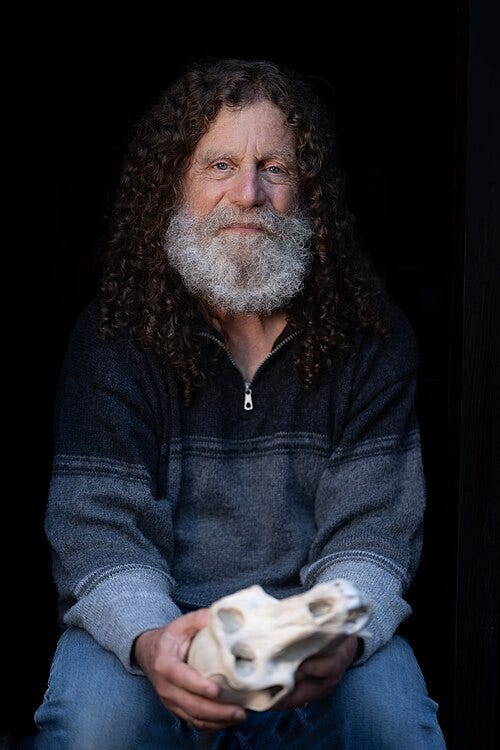
If people can’t help what they do, I have no reason to admire them or hate them. They just are, like rocks. Some people find comfort in that idea. In the last months of his life, a friend became a big fan of Robert Sapolsky, a Stanford intellectual and YouTube star who says we don’t have free will. My dead friend found a lot of comfort in thinking people aren’t in control of their choices. Choices are biologically and socially constructed, and we’re just acting, not choosing. That idea makes a lot of sense if we think about addicts. Addicts don’t choose to be addicted. It’s the opposite of choice; it’s compulsion.
Speaking of addictions, I’ve been thinking about death. There’s a lot to like about death. We can count on it, and there’s not much we can count on. No matter how bad things get, we can always escape them. You don’t have to pay taxes when you’re dead, or stand in line. Most of us don’t choose to die — we just die. Alex, my friend who died, couldn’t stand his air hunger anymore, and he was in pain from his cancer. He chose to die. He told his nurses to turn off his machine and that he accepted the end of life. I hope I can do that. And I hope that when I’m dead, that’s it. Life after death would be horribly disappointing. I’m tired a lot now, and I’m only 57. It’s going to get a lot worse. When my life is over I want it to be over, like the time before I was born. That time is meaningless. Non-existence feels like sweet relief. I love my life, but my death means nothing to me. Ah, yes — but it will mean something to the people I love and who love me, and there’s the rub.
Alex’s children live in Europe. His wife was with him when he decided it was time to die. Would he have done the same with his children or his grandson there? Yes, but it would have been messier. I have an idea for a black comedy where the protagonist has been planning his death for years. He’s going to kill himself on his 70th birthday. He’s talked to everyone he loves about it, made financial and other plans based on knowing the day he is going to die — financial planning is a lot easier if we know how long we’ll live — but no one takes him seriously. Then when he starts real preparations, everyone panics, and it’s a struggle between his desire to die and the desires of the people who love him. (It’s funny in my head.) This story has probably already been written. Maybe even by an AI.
There was briefly a business that made AI imitations of the voices and speech of people who had died, so loved ones could keep them around. Horrible. I believe this misbegotten business rightfully and blessedly went bankrupt. A lot of AI enthusiasm will end this way. It’s like when Harrison Ford’s character drives off into the sunset with Sean Young’s replicant character at the end of Blade Runner. She’s pretty, but gross! She’s a robot! It’s as romantic as driving off with a sex doll. “More Human Than Human” was the slogan of the man who made replicants — robot imitations of human beings who did unpleasant jobs, like being soldiers or sex workers. I would think having sex with a robot, a theme that appears in several science fiction movies, would be like reading a novel written by AI: lifeless for some, perhaps better than the real thing for others. For me, I’ll stick with real people.
“If you don't know how to die, don't worry; Nature will tell you what to do on the spot, fully and adequately. She will do this job perfectly for you; don't bother your head about it.” — Montaigne